Projects
Student work that shipped.

2024–25
Featured Student Venture · CES Eureka Park
Sunflower
AI-Powered Indoor Air Quality Sensor · Matthew DuBois '26
Matthew DuBois '26 identified a gap hiding in plain sight: most indoor air quality sensors look and feel like scientific instruments — dense with raw data, stripped of design, leaving users with no real understanding of what the readings mean. His answer was Sunflower: a compact, beautifully designed air quality monitor that uses AI to translate CO₂, VOC, humidity, and particulate data into clear, actionable guidance — something you'd be glad to leave in your living room, office, or child's bedroom.
After earning early backing from the Torrey Explorers Fund and the Reifschneider Endowed Award, Matthew built a functioning product over the summer — teaching himself advanced electronics using ChatGPT and YouTube alongside his Design & Innovation coursework. A Friends & Family funding round followed, attracting not just capital but mentorship from investors who called him the most organized, detailed, and informed founder they'd ever backed.
"There's something about the face-to-face collaboration. We got more done sitting in the conference room for an hour than we had in all the hours of talking on the phone and in emails." — Matthew DuBois '26

CES
Eureka Park · Las Vegas
TEF
Torrey Explorers Funded
AI
Data → Insights
'26
Current student founder
2024 Congressional App Challenge Winner
CheckPoint Student
NFC Attendance Platform · Matthew DuBois '26 & Luke Graham · ckpnt.com
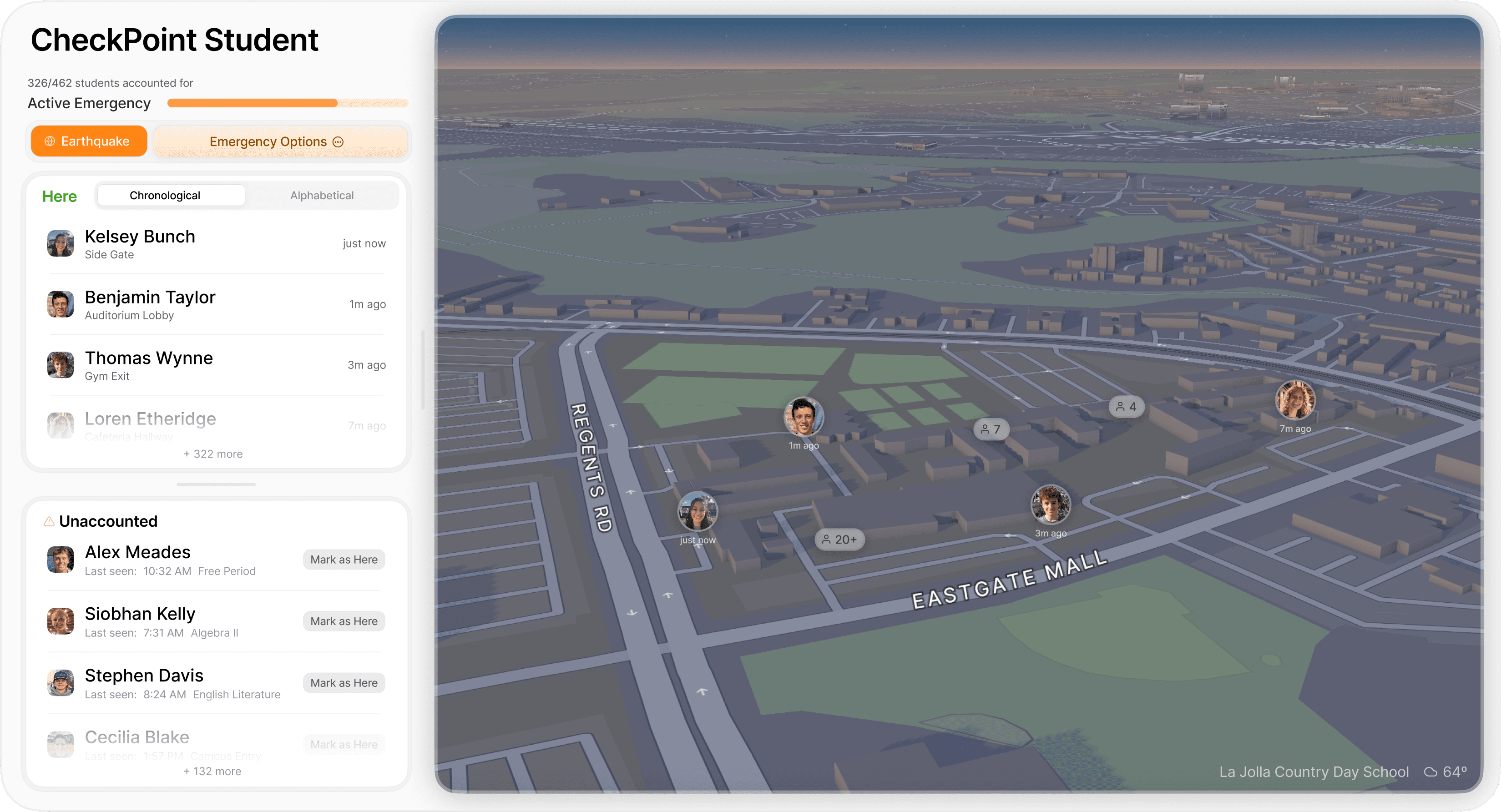
Matthew and his co-founder Luke Graham spotted a friction point hiding in plain sight: during free periods at LJCDS, students had to drop everything, walk across campus, and write their name on a clipboard to confirm attendance. Their answer was CheckPoint Student — a campus presence system that lets students tap their phone to any CheckPoint node using NFC, the same technology behind contactless payments. Nodes are 5mm thin, require no power and no internet, and can be deployed anywhere on campus instantly. An Emergency Rapid Response Mode enables staff to account for every student's location during a crisis. The Manager dashboard gives attendance staff a single place to view data across all checkpoints, track audit logs, and monitor configurations — designed in close collaboration with LJCDS attendance staff who were treated as primary end-users throughout development.
All processing happens on-device — sensitive data is never exchanged with a CheckPoint node. Every interaction is secured by a dynamically calculated encryption key. The product is live at ckpnt.com, patent pending.
Winner, 2024 Congressional App Challenge — California's 50th District (Rep. Scott Peters). Invited to showcase at the annual #HouseOfCode festival at the U.S. Capitol. One of 3,881 apps submitted by 12,682 students nationally.
2024 Congressional App Challenge by the numbers
12,682
Students competing nationally
382
Members of Congress hosting — a record high
#1
CA-50 District Winner


2024–25 K–12 Interdisciplinary · Lower + Upper School
3rd Graders Launch a Balloon to the Stratosphere
High-Altitude Balloon Project with Blue Dot Education
It started in the third-grade Design & Innovation class, where 8-year-olds designed parachutes, planned experiments, and decided what questions they wanted to ask the atmosphere: How do marshmallows change under low air pressure? What happens to temperature at 100,000 feet? On launch day, they released a helium-filled balloon from the LJCDS varsity field. It climbed to approximately 100,000 feet — where atmospheric pressure dropped so low the balloon expanded to 20–30 feet in diameter before bursting — then drifted more than 50 miles east, finally landing on a rugged mountainside near Julian, CA. Dan Lenzen and Matthew DuBois '26 hiked through dense brush to recover the payload.
The payload — a lunchbox full of cameras, sensors, and experiments — was built by Upper School students Anthony Casey '28, AJ Hamson '28, and Matthew DuBois '26 in the Innovation Lab. They used Arduino microcontrollers, 3D printing, and sensor integration to build instruments measuring acceleration, altitude, and temperature, built to the exact specifications the third graders requested. On recovery, the data flowed back into the third-grade science curriculum — connecting the balloon flight directly to their study of atmospheric layers, gas behavior, and weather cycles. The project was guided by Blue Dot Education, which has supported over 30 student-led high-altitude balloon launches nationwide, providing real-time GPS tracking throughout the flight.
The project is a model for the new HUB for Human Impact — a space where students from every division collaborate on real-world challenges. Third graders drove the vision; high schoolers built the hardware; the stratosphere was the classroom.
2015–16 Industry Partnership
Hydrone
CamelBak × LJCDS Design & Innovation
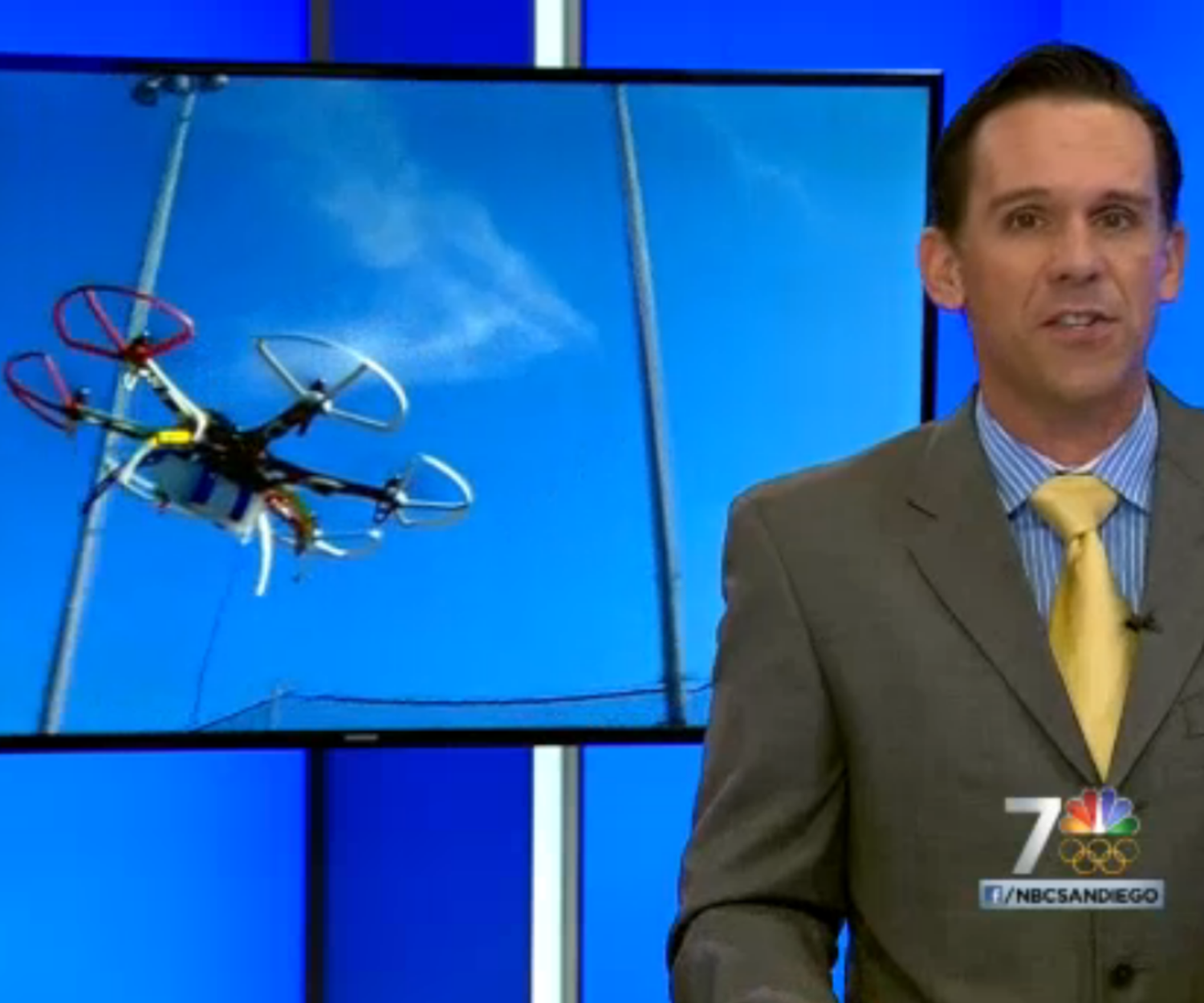
Working with CamelBak's Lead Industrial Designer on the brief "Hydration in Team Sports," a team of three seniors conducted ethnographic research with athletes across multiple sports — observing in context, interviewing coaches, and identifying non-obvious patterns. They developed the Hydrone: a sideline hydration system designed around the actual timing and social dynamics of team competition. The team traveled to CamelBak's HQ in Petaluma, CA to present their work. Their project was featured on NBC7 News and covered by SportTechie and Vocativ.
Featured on NBC7 News, SportTechie, and Vocativ.

2016 Student Venture
Meraki Skate
Student-Founded LLC
Students Dan Schott and Rostam Reifschneider founded Meraki Skate, LLC to solve a real problem: bringing a skate tool to sessions. Their slide pucks integrate a kingpin tool directly into the puck design. They 3D printed and tested multiple iterations with professional and amateur longboarders, incorporated the company, filed a provisional patent with the USPTO, secured VC funding from the Torrey Explorers' Fund, and sourced manufacturing in China and locally in San Diego.
Our first manufactured product.

2019 Industry Exhibition
Int'l Housewares Show
Chicago, McCormick Place
LJCDS students designed, developed, and exhibited original consumer products at the International Home + Housewares Show in Chicago — a trade event attended by over 60,000 people from 2,200+ exhibitors. Student-invented products included Collapsicatch (collapsible splatter shield), Steam Shield (intelligent pot cover), Blend (camera concealment design), and BrewStop (magnetic pour-over stopper). Students pitched to industry executives — and some received licensing discussions. Featured on WGN-TV News.

2018–19 Research Partnership
La Jolla Institute for Immunology
Lab Tools for Scientists
Dan guided Middle School students to collaborate with researchers at the La Jolla Institute for Immunology, a world-renowned biomedical research institution. The students designed and built laboratory tools and equipment that LJI's working scientists now use in their research. This is real-world impact: not simulated projects, but tools deployed in a professional lab environment.